Release Notes
RDF4J 5.2.0 is a minor release that fixes 9 issues.
Highlights Explain plans over HTTP. You can now request EXPLAIN via the REST API, making it easier to diagnose and tune slow SPARQL queries. SPARQL queries using MINUS and OPTIONAL clauses are significantly faster. Performance improvements to the LMDB Store, reducing query time by an average of 50% and reducing overhead for concurrent queries. Configurable LMDB GC. A new valueEvictionInterval lets you tune (or disable) LMDB value‑cache garbage collection to balance latency vs.
RDF4J 5.1.6 is a patch release that fixes 12 issues.
For a complete overview, see all issues fixed in 5.1.6.
Acknowledgements This release was made possible by contributions from Jerven Bolleman, Piotr Sowiński, Håvard M. Ottestad and kenwenzel.
RDF4J 5.1.5 is a patch release that fixes 5 issues.
For a complete overview, see all issues fixed in 5.1.5.
Acknowledgements This release was made possible by contributions from Andreas Schwarte, manuelfiorelli, Kacper Grzymkowski.
About
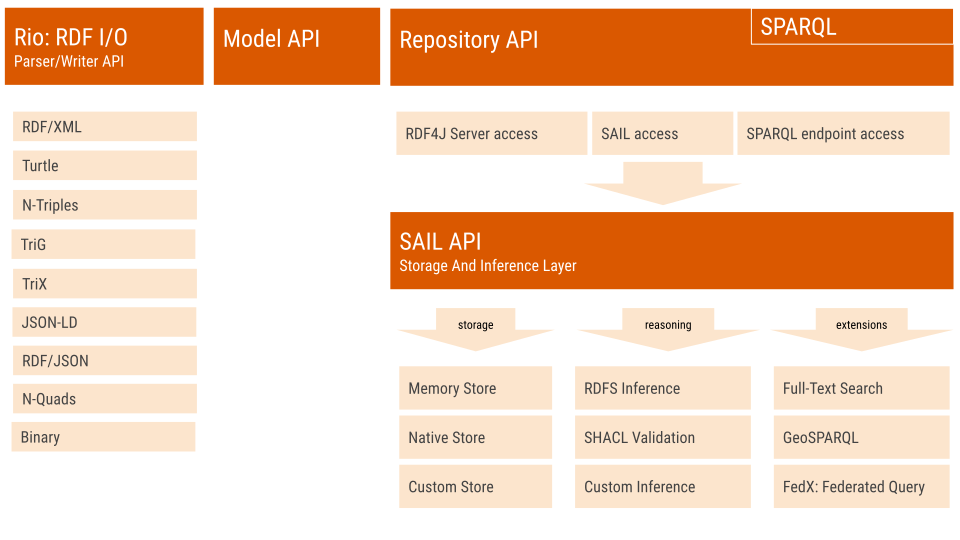
Eclipse RDF4J™ is a powerful Java framework for processing and handling RDF data. This includes creating, parsing, scalable storage, reasoning and querying with RDF and Linked Data. It offers an easy-to-use API that can be connected to all leading RDF database solutions. It allows you to connect with SPARQL endpoints and create applications that leverage the power of linked data and Semantic Web.
 ™
™